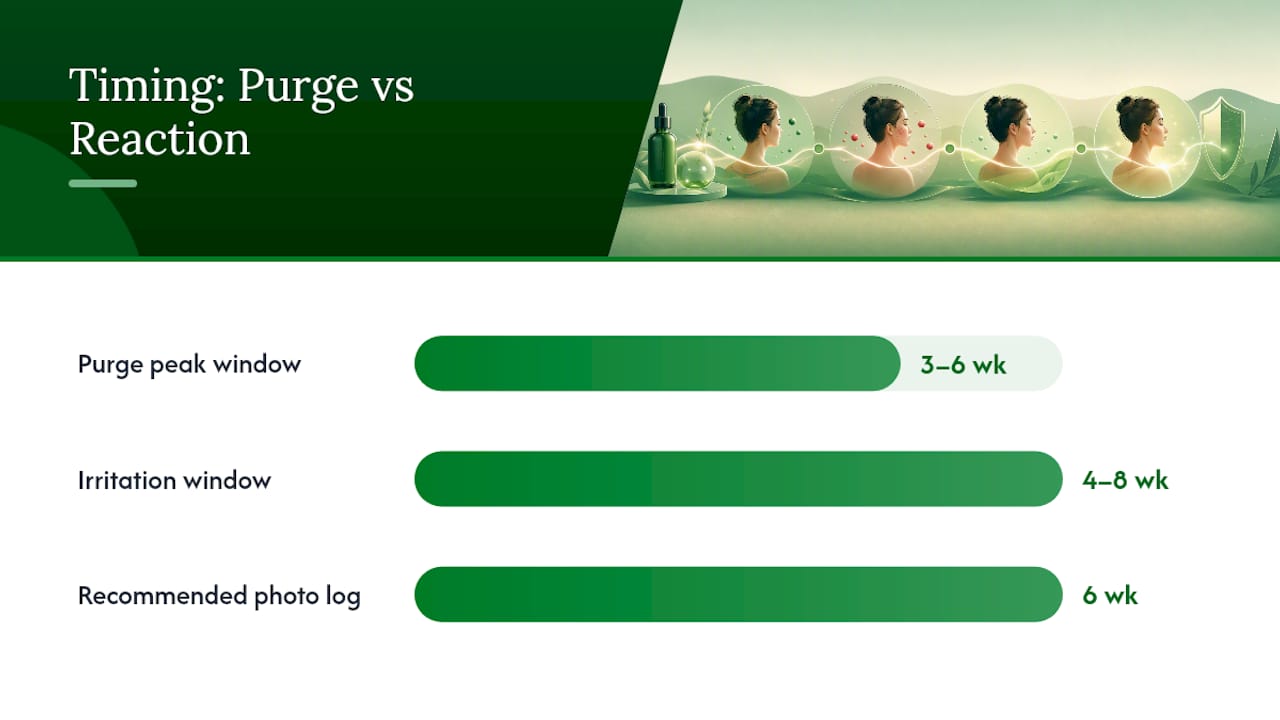
Most tretinoin purges run 4 to 6 weeks, with the broader typical window landing at 4 to 8 weeks. Breakouts tend to peak around weeks 3 to 6, then start calming down as your skin’s turnover cycle catches up with the medication. Give it a full 12 weeks before judging results, and call a provider if things keep getting worse past that point or spread to skin that’s never broken out before.
TL;DR:
- Most purges last between 4 to 8 weeks, with peak breakouts occurring from weeks 3 to 6, and typically improve by week 12.
- The severity and duration of the purge depend on baseline acne severity, product strength, skin health, and environmental factors.
- Differentiating a purge from irritation involves examining lesion location, character, pain level, and whether symptoms peak and then improve.
- Reducing product use during purging, avoiding new actives, and daily sunscreen are key strategies to manage symptoms without worsening your skin.
- Persistent breakouts after 12 weeks or new, severe symptoms require professional assessment to adjust treatment or rule out other issues.
Table of Contents
- Tretinoin Purge Timeline: Why Your Skin Gets Worse Before It Gets Better
- Why Some People Purge Hard and Others Barely Notice
- The Week-by-Week Tretinoin Purge Timeline
- Purge or Breakout? How to Tell the Difference
- Managing the Tretinoin Purge Without Making It Worse
- When to Expect Results and When to Call a Provider
- When Telehealth Makes Sense for Tretinoin Management
- A Realistic Way to Get Through the Rough Weeks
- Get Professional Guidance for Your Tretinoin Journey
- Sources
- FAQ
Tretinoin Purge Timeline: Why Your Skin Gets Worse Before It Gets Better
Tretinoin doesn’t create new acne out of nowhere. It speeds up how fast your skin cells turn over, and that faster cycle drags clogged material to the surface that was already sitting under your skin, invisible, for weeks or months. Dermatologists call these microcomedones, and they’re the raw material of every future whitehead, blackhead, and papule you were going to get anyway.
Normal skin cell turnover takes somewhere around 28 to 40 days. Tretinoin compresses that to roughly 14 to 21 days early in treatment. That’s the entire mechanism behind the tretinoin purge: you’re not developing new problems, you’re fast forwarding through old ones.
This is actually a decent sign, not a bad one. A purge means the medication is doing exactly what it’s supposed to do, clearing out a backlog rather than manufacturing fresh trouble. A few things happen simultaneously during this window:
- Microcomedones that would have surfaced over months instead show up in weeks
- Skin barrier function temporarily dips, which is why dryness and flaking show up alongside the bumps
- Cell turnover accelerates enough that dead skin sheds faster than your moisture barrier can compensate
None of that means every breakout on tretinoin is a purge. But the timing and location pattern described below is what separates a real purge from something that needs a second look.
Why Some People Purge Hard and Others Barely Notice
Not everyone gets the same experience, and the variation isn’t random. It tracks pretty closely with how much acne-in-waiting your skin was carrying before you started.
If you had moderate to severe acne with a lot of unseen microcomedones, expect a more visible purge. Clearer skin with fewer hidden clogs usually means a milder one, sometimes barely noticeable. Beyond your baseline, several variables shift the timeline and intensity:
- Concentration and frequency: 0.025% cream applied every other night behaves very differently than 0.1% gel applied nightly. Higher strength and more frequent use usually mean a faster, more intense purge.
- Skin type and barrier health: dry or already-compromised skin barriers tend to show more irritation layered on top of purging, which can make the whole process look worse than it is.
- Prior actives: if you were already using exfoliating acids or retinol before switching to tretinoin, your skin may adapt faster since some of that turnover adjustment already happened.
- Concurrent products and environment: harsh cleansers, alcohol-based toners, dry winter air, or heavy sun exposure all compound irritation and can stretch out how long the rough patch feels.
None of these factors change the underlying biology, but they do explain why your friend breezed through their first month on tretinoin while you’re staring at your chin in the mirror wondering what went wrong.
The Week-by-Week Tretinoin Purge Timeline
Here’s what a typical progression looks like, mapped against the pattern dermatology sources and clinics consistently report.

1. Days 1 to 7: quiet setup
Nothing dramatic usually happens in the first week. Tretinoin is binding to retinoic acid receptors in your skin cells and beginning to accelerate turnover, but visible changes lag behind that cellular activity. You might notice mild dryness, a little tightness, or slight redness, especially if you’re applying every night out of the gate. Actual new lesions are uncommon this early. If your skin already looks angry in week one, you’re probably overdoing frequency or amount, not experiencing a purge.
2. Weeks 2 to 4: the purge begins
This is where most people start seeing what they came for, and not in a good way. Comedones that were sitting below the surface start pushing up, typically in the same zones you already break out in: chin, jawline, forehead, cheeks near the nose. Papules and small pustules tend to increase during this stretch. According to the week-by-week pattern dermatology-reviewed sources describe, this is the window where purging becomes unmistakable rather than theoretical.
3. Weeks 3 to 6: peak purge
Brace yourself, because this is usually the roughest patch. Multiple clinician-reviewed sources converge on weeks 3 through 6 as the point where breakouts and flaking hit their worst. You may see the highest number of active lesions of the entire process here, plus the most visible dryness and peeling as accelerated turnover keeps sloughing dead skin faster than your moisture barrier can keep up.
A quick reality check on numbers: the tretinoin purge most commonly runs 4 to 6 weeks, though the full typical range extends to 4 to 8 weeks depending on your starting point and product strength, according to SKŌR’s clinical overview. If you’re at week 5 and still breaking out, you’re still inside the expected window, not outside it.
4. Weeks 6 to 8: things start settling
New lesions typically slow down noticeably here. Existing ones start healing faster instead of being immediately replaced by fresh ones. Flaking usually eases up too, since your skin barrier has had time to partially adjust to the faster turnover rate. This is the stage where a lot of people start feeling cautiously optimistic instead of ready to quit.
5. Weeks 8 to 12: visible improvement for most users
By this stretch, many people see a clear drop in overall lesion counts along with smoother texture. Skin tone often looks more even too, since active breakouts have had time to heal without new ones constantly interrupting the process. Twelve weeks is the point dermatology guidance generally points to for judging whether an acne treatment is actually working, since acne treatments in general need multiple weeks before their effect becomes obvious.
If you’re past week 12 and your skin looks the same or worse than when you started, that’s worth a conversation with a provider rather than more waiting. Continued patience past that point stops being reasonable and starts being a missed signal.
Purge or Breakout? How to Tell the Difference
This is the question that keeps people up at night scrolling through forums at 1 a.m. Here’s a practical way to sort it out.
Location matters first. A genuine purge shows up where you already tend to break out. If you suddenly have lesions on your temples, neck, or back and you’ve never had acne there, that’s a signal to look at irritation or an allergic response rather than assuming purge.
Lesion character and pain level matter next.** Typical purge lesions are comedones, small papules, and the occasional pustule, uncomfortable but manageable. Severe pain, blistering, widespread stinging, or swelling that doesn’t fade within an hour of application points toward irritation or a reaction, not a purge. The Mayo Clinic’s guidance on topical tretinoin lists dryness and irritation as expected effects, but flags severe reactions as a reason to contact a provider.
Time course is the tiebreaker. A purge follows the arc above: it peaks around weeks 3 to 6 and then improves. Irritation tends to do the opposite. It either stays flat with no improvement by weeks 4 to 8, or it keeps getting steadily worse without ever peaking and turning around.
- Purge: same zones as usual acne, peaks then fades, lesions you recognize
- Reaction: new zones, unusual pain or blistering, worsens steadily with no turnaround
- Irritation: redness and burning tied closely to application, eases as barrier adapts
Pro Tip: Take one photo a week, same lighting, same angle, and jot down a single number from 1 to 5 for how your skin feels that day. Six weeks of that simple log tells you more about whether you’re purging or reacting than staring in the mirror every morning ever will.
Bring that photo log and symptom notes to any provider visit. It turns a vague “my skin looks worse” into something a clinician can actually assess.
Managing the Tretinoin Purge Without Making It Worse
The instinct to fight back with more products is exactly the wrong move here. Less is almost always the better strategy while your skin adjusts.
- Start low and go slow. Apply tretinoin two to three nights per week for the first two to three weeks rather than nightly. Some people use the “sandwich method,” applying moisturizer, then tretinoin, then another layer of moisturizer, to buffer the initial irritation. Both approaches slow the adjustment curve without blocking the medication’s effect.
- Simplify your routine to the basics. A mild, fragrance-free cleanser and a plain moisturizer are doing more good right now than any serum with a long ingredient list. Layer moisturizer generously after tretinoin, and again in the morning before sunscreen.
- Wear sunscreen every single day, no exceptions. Tretinoin increases sun sensitivity, and unprotected sun exposure during an already-irritated period sets you up for lingering discoloration once the purge clears. This is one of the most consistent points across medical guidance on tretinoin’s side effects.
- Skip new actives entirely during the purge. Adding AHA or BHA exfoliants, benzoyl peroxide, or a new retinol product on top of tretinoin during weeks 2 through 8 usually backfires. It stacks irritation on top of an already-stressed barrier instead of speeding anything up. If you’re curious about how retinol and tretinoin actually differ in strength and mechanism, this comparison from Nexgen Clinic breaks it down clearly. And if you’re shopping for a gentler layering product once your skin has adjusted, something like a retinol smoothing toner fits better after the purge phase than during it.
- Skip physical exfoliation completely. Scrubs, cleansing brushes, and wash cloths scrubbed too hard will tear at a barrier that’s already thinner and more reactive than usual. Your fingertips and a gentle cleanser are enough.
- Know when to scale back frequency or talk to a provider about strength. If irritation is severe enough that you’re peeling constantly, stinging at rest, or avoiding the medication out of dread, dropping to every third night for a week or two is reasonable. If that doesn’t help within two weeks, a provider can discuss a lower concentration or a different vehicle formulation.
Pro Tip: Moisturize before tretinoin on nights your skin feels extra sensitive, not after. A thin buffer layer underneath slows absorption just enough to blunt the sting without meaningfully weakening the treatment’s effect over time.
When to Expect Results and When to Call a Provider
Most people see their first real improvement somewhere in the weeks 6 to 12 window. That’s not a guess. It’s the timeframe dermatology sources consistently point to for judging whether an acne treatment is working, and it matches the pattern seen across multiple clinical timelines for tretinoin specifically. Twelve weeks is the natural checkpoint for deciding whether to stay the course or ask for changes.
A handful of situations mean you shouldn’t wait for that checkpoint to arrive:
- Breakouts keep intensifying past week 12 with no sign of turning a corner
- New lesions show up in areas you’ve never broken out in before
- You’re experiencing severe pain, not just discomfort, at the application site
- Signs of infection appear: warmth, swelling, pus, or spreading redness
- Stinging or burning happens even when you’re not actively applying product
If any of those show up, it’s worth reaching out sooner rather than riding it out. Come prepared with your photo log, a written timeline of when symptoms started and changed, and a list of every product currently in your routine including cleansers and moisturizers. That level of detail helps a provider tell within minutes whether you’re dealing with a stubborn purge, an irritant reaction, or something else entirely, like folliculitis or a genuine allergic response.
When Telehealth Makes Sense for Tretinoin Management
A virtual visit covers more ground than most people expect. A provider can review your photos and timeline to sort purge from reaction, adjust your application schedule or concentration, and switch you to a different formulation if the current one is too harsh for your skin.
Topweightlossmed’s skincare service handles exactly this kind of check-in, alongside prescription management and insurance-aware cost guidance so you’re not guessing what a refill will actually cost. For anyone dealing with ongoing tretinoin side effects, understanding what tretinoin costs with insurance ahead of a visit can also make the decision easier.
Before a telehealth appointment, gather three things:
- Weekly photos covering the timeframe you’ve been on treatment
- A current list of every medication and skincare product you’re using
- A short symptom log noting when things got worse, better, or stayed flat
That prep turns a 15 minute virtual visit into something genuinely useful instead of a rushed guessing game.
A Realistic Way to Get Through the Rough Weeks
Twelve weeks sounds like a long time when your skin looks worse than it did on day one. It isn’t, in the context of how long those microcomedones had been sitting under the surface before tretinoin ever touched them. Committing to roughly a 12 week trial, barring any red flags, gives the medication enough runway to actually finish the job instead of judging it mid-process.
The single habit worth adopting is embarrassingly simple: one photo a week, same lighting, plus a one-line note rating that day’s skin from 1 to 5. It takes fifteen seconds and it’s the difference between panicking at week 4 and recognizing, by week 7, that you’re already past the worst of it.
If a red flag shows up, don’t try to diagnose it yourself from a forum thread. Get a provider’s eyes on it early. Guessing wastes the exact weeks you need to either stay the course or pivot to something that actually works for your skin.
— Bryan
Get Professional Guidance for Your Tretinoin Journey
Figuring out whether your skin is purging correctly or reacting badly shouldn’t rest entirely on your own judgment, especially in weeks 3 through 6 when things look worst. Topweightlossmed gives you a same-day telehealth consult with a real provider who can look at your photos, review your product list, and tell you in one visit whether to stick with your current routine or adjust it.

Through Topweightlossmed’s skincare service, you get prescription management, insurance-aware pricing so you know costs upfront, and medication delivery instead of a pharmacy trip. That continuity matters if you’re also managing other health concerns, since Topweightlossmed keeps primary care and specialty treatment on one platform rather than scattering your care across separate providers. If you’re three or four weeks into a rough purge and unsure whether to push through or change course, book a consult and get a direct answer instead of another night of scrolling forums for reassurance.
This article is general information, not a substitute for advice from a qualified doctor. Consult a qualified healthcare professional about your own circumstances before acting on anything here.
Sources
- The Tretinoin Purge: What It Is and How Long It Lasts | SKŌR
- Tretinoin Purge: Week-by-Week Timeline & How to Tell It’s Working | Medsbase
- Tretinoin topical: Side effects | Mayo Clinic
- Acne overview | American Academy of Dermatology (AAD)
FAQ
How Long Does Tretinoin Purging Usually Last?
Most purges run 4 to 6 weeks, with the fuller typical range landing between 4 and 8 weeks. Visible improvement in texture and lesion count usually continues building through weeks 8 to 12.
When Is the Tretinoin Purge at Its Worst?
Peak purging most commonly hits between weeks 3 and 6, when the highest number of surfaced comedones and papules tend to appear alongside noticeable dryness and flaking. Things generally start calming down after that window closes.
How Long Do the “Tretinoin Uglies” Last?
The rough patch people call the tretinoin uglies, the combination of breakouts, dryness, and flaking, typically overlaps with the 4 to 6 week purge window and starts easing by weeks 6 to 8. Consistent moisturizing and daily sunscreen help shorten how uncomfortable that stretch feels, even though they don’t change the underlying timeline.
Why Am I Still Breaking Out After 6 Months on Tretinoin?
Purging alone shouldn’t still be active at six months. That timeframe points to either an ongoing irritant reaction, a hormonal or dietary trigger unrelated to tretinoin, or a need to adjust concentration or frequency with a provider. A telehealth skincare consult can help sort out which one applies to you.
Is Purging a Sign That Tretinoin Is Working?
Generally, yes. A purge means tretinoin is accelerating cell turnover and pushing existing microcomedones to the surface faster than they would have appeared on their own. That said, breakouts appearing in brand new areas or lasting well past 12 weeks point away from a simple purge and toward something worth a provider’s review.